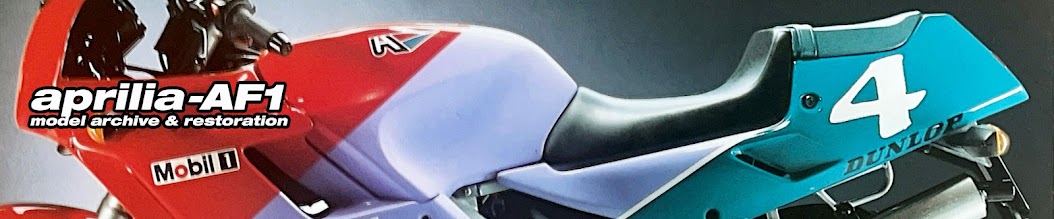
This was one of the first UK road tests for the Aprilia AF1 Project 108 dating from January 1988.
HELLO, I LOVE YOU
Never heard of Aprilia? You will if they make any more bikes like the AF1 125.
"Two coffees please." "Coming up darlin'. Anything else?" "Nope."
Buying a hot drink from the cafe next to the local Kawasaki shop takes about 90 seconds. Add on an extra 30 for the time it took to stick my head round the door to ask 125 Bol d'Or veteran Trev whether he wanted one lump or two and that means whoever had stolen the Aprilia AF1 125 had managed it about two minutes. With the steering lock on. In broad daylight. There could only be one explanation.
They're an opportunist bunch of kidnapping wasters at Peterborough Kawasaki and their curiosity had got the better of them. The bike was up on a bench in the workshop, the sidepanels and seat already off and Mick the mechanic guiltily trying to get the tank unbolted before I could see him.
Not that you could blame them. Wherever the Aprilia went, everybody with the slightest interest in bikes wanted to have a go, know how fast it went or guess how much it cost. The AF1 125 is new in a way that no other bike in the last few years has been. Even wild, way out race replicas like Honda's NS400 had some kind of forerunner, if only a GP bike with the cylinders pointing in different directions.
The Aprilia has such no such pedigree. In evolutionary terms, it just sprung out of the ground. Or to be more precise, it sprang out of Aprilia's new factory in Noale, Italy. And the truly amazing thing is how such a bike came from nowhere to rival the best Japan can produce.
Until late 1986 Aprilia were best known in the UK for making trials bikes, dodgy Ducati Pantah headlights and (once upon a time) motocrossers. Then came the Olympia show and Aprilia's first three road bikes — a 50cc, 8 1/2 bhp, electric start moped, an enduro-styled 250 and a 350cc trail bike. Factory personnel at the time talked of multi-millions pound investment, 31 new models and five new engines over the next five years. Things didn't turn out quite that rosy but one year and a 250 GP win later the 125 'world beater' they promised was ready.
It's a stunner. If visual appeal could be measured on a dyno, the AF1 125 would make a lot more than 22 horsepower. Being Italian, Aprilia have rightly deduced that one of the best things to do on a motorcycle is be seen on it, preferably by several members of the opposite sex. In styling terms the colour scheme is inspired, the bodywork pinched from established success stories and the single sided swingarm a stroke of genius.
The Rotax motor starts first push of the button and even in cold weather ticks over without choke. The clutch is smooth enough for gentle getaways and useable, even power is available anywhere between 4,000 and 9,500rpm. Achieving that kind of spread from a 22bhp 125 suggests that Rotax know exactly what they’re doing, though there may not be much room left for improvement. On its first tank of fuel the AF1 would knock merrily almost anywhere in the rev range. JR, who is now our resident combustion expert (see page 16), diagnosed the gentle rattling noise as pre-ignition which usually means the engine is asking for a higher octane fuel.
This suspicion was confirmed when he found out that the Italians, with the environmental sensitivity of a rotting sheep, still haven’t reduced the lead content of their petrol and can therefore get away with higher compression ratios on production bikes. JR’s theory was that low octane UK fuel was bringing the Aprilia right to the limit. We tried the next tankful with Silkolene Pro Boost octane booster which stopped the rattling but is a touch expensive for street use. As a cheaper alternative JR suggested Motul synthetic two stroke oil which tends to smooth out combustion, but we never got round to trying it. We later found that the rattles also disappeared in cold, damp weather.
The best 125 roadster engine at the moment is Yamaha’s TZR. In comparison the Aprilia isn’t as crisp; there’s a slightly less direct connection between right wrist spasm and rear wheel thrust. It’s not a problem; in fact if you’re trying to ride smoothly with a passenger this engine is easier to use. Besides, few UK TZRs have the servo motor fitted which means they’re either in docile 12bhp form (Power Valve down) or sod all-below-seven-grand form (Power Valve up). The Aprilia gets near the best of both versions, but without taking it and an unrestricted TZR to MIRA on the same day it’s impossible to know which is fastest.
At any rate there’s enough power to scream the AF1 out of corners in fine style, though the 8,000-9,500rpm optimum squirt mode means you have got to be in the right gear every time. On motorways it’ll cruise happily at an indicated 130km/h (81mph); with a tail wind it’ll hit the redline in top (145km/h) even with a passenger.
All this with no power valve. Or so we thought, gazing blankly at the mysterious RAVE unit above the exhaust port. It looked like a power valve but the only cable on it led to the rear brake lever. After much head scratching we faxed the factory who explained that RAVE was an automatic system operated by exhaust gas pressure. The cable attachment was merely ‘to obtain frequent discrustation’.
In many ways the Aprilia feels like a Japanese bike. Things like seat/handlebar/footrest positions, tank shape, switchgear and most of all instruments bear an unsubtle similarity to an RG250 Mk3. This is a good thing because compared with Japan, Italy’s accumulated knowledge of ergonomics could have been written on the inside of a mouse’s ear.
It’s only when you notice the ride quality, brake feel and ultra-light, precise steering that you begin to realise the Italian bike industry is well and truly out of the dark ages. Bar the Paso and the odd Bimota (which nobody but Oxley and his jet setting buddies will ever get to ride) the AF1 is the first bike from Italy with real suspension.
Far softer at both ends than you’d imagine, it makes the bike comfortable and fast. Nothing twists or flexes, the rising rate rear end actually works and the anti dive on the righthand fork leg doesn’t. Mix in light, stable steering and you’ve got a first class scratcher. Short, choppy bumps in the road don’t make any impression. Bigger undulations waggle the bars from side to side and make the bike yaw slightly. This is all as it should be; many 750s behave in much the same way.
The mid November weather never let the Arrowmax tyres get hot but they gripped fine, and in the wet the bike was particularly easy to ride. Even sitting a passenger on the back didn’t upset the steering or handling. Pillion accommodation, by the way, was standard 125 issue — reasonably comfortable seat, no grab rails and footrests about a foot higher than they should be.
Complaints from female pillions were drowned out most of the time by appreciative murmurs. It makes me blush to explain why but apparently the vibrations reaching the Aprilia’s rear seat are just the right frequency, if you know what I mean. It seems that the resemblance to the Mk 3 Gamma goes a lot deeper than was first thought.
At the track the AF1 hit an indicated 9,700rpm in top fairly rapidly and stayed there, giving 92.5mph in still air. As the factory claim 93.75mph we thought this was about right, especially as we’d earlier seen 10,000rpm in top down a particularly long hill. Importer Robert Jackson was a bit disappointed (the Italian magazine Moto Sprint got 97mph) but it’s still quick.
On the standing quarters the clutch developed the sudden, graunchy, notchy feel which we noticed on the Gilera 125s last year. It wasn't that much of a problem; it just seems to be a characteristic of Italian lightweights. But in case it was doing any damage I limited the quarters to three runs. The bike’s too high geared to produce scorching ETs anyway.
High gearing also made it difficult to pull wheelies off the throttle, and as using the clutch for frontal aviation is hideously uncool the best method turned out to be whacking the throttle open at six grand whilst simultaneously riding over a bump. On the other hand the AF1 pulls the best stoppies in the business. It's quite easy to get the back wheel in the air whilst still travelling at a reasonable speed. No other 125 I’ve tried seems to want to do this. Naturally we can’t recommend such behaviour on the public highway.
So the AF1 goes, stops and handles beautifully. Equally importantly, it cuts a certain dash on the street. The rising rate linkage, single sided swingarm is the first in the country, even beating Honda’s RC30 into the showrooms. The electric start is more than any current Japanese two stroke has got. The fairing’s internal panelling is a luxury usually reserved for big touring bikes. Then there’s the gold plated chain, Dymag-type wheels, CBR-style rear mudguard and indicators that are works of art — all these things heap lashings of street cred on an already impressive design.
All the more sad, then, that the Aprilia’s major flaw is its finish; despite Windy Corner’s immaculate preparation the demo bike was starting to get tacky after only a day or two of rain. The fairing screws were corroding. The paintwork round the filler cap was stained yellow. The rear mudguard, which appeared to be made of the same soft material as a washing up bowl, was proving almost impossible to wash effectively. Cleaning also showed up a poor fitting bellypan, and the bike as a whole didn’t have a new Japanese bike’s ability to shrug off dirt and grease. The AF1 could be kept looking good, but it’d take a hell of a lot of loving care.
Two point three grand is far too much money for a 125. Is it worth it? A TZR, plus servo motor, plus optional full fairing retails at £1700 so in strict cash terms you could get the same performance, handling and basic spec for less if you bought a Yamaha. Against that the AF1 is the trickest road 125 in the country, and the factory’s decision to pitch it at the high tech end of the market is a very brave one. Besides, it’s aimed at rich full licence holders rather than penniless learners.
We think it’s great that the Italians are ending years of stagnation and are starting to produce bikes that don't require rose tinted spectacles, a subscription to Motorcycle Sport and blind loyalty for their proper appreciation. All we need now is for Guzzi, Morini and Laverda to catch up.
RP
SIDEBAR: Stop Press
Lusting learners don't have long to wait; the first 12bhp AF1s will arrive in January. The first ten unrestricted ones sold out before they even reached the country.
At the time of going to press USAB had signed up 15 dealers throughout the UK. Spares availability should be reasonable — USAB are stocking everything the factory recommend. Tricky items can be air freighted across the channel in seven days if you’re desperate but it will be expensive. Meanwhile Rotax are working on a tuning kit which should be available after Christmas.
Aprilia will be racing in 250GPs again in ’88 and three works bikes have just been sold in Britain. If all goes well you'll be reading about the 250 AF1 race replica this time next year.