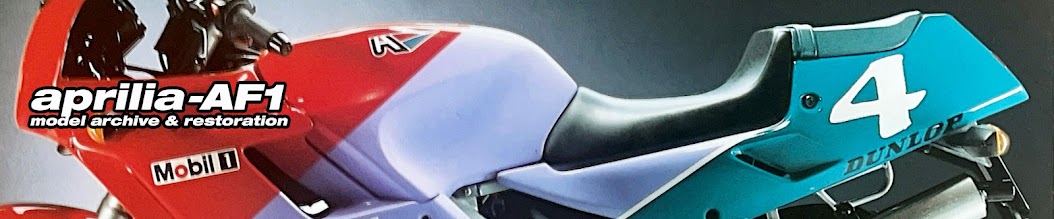

The complete text for the Performance Bikes AF1 Futura review: October 1991
Aprilia AF1 Futura £3,591
For a fully-developed, flexible road bike, the 28.4 horsepower Aprilia is really quite astonishing and, at 227bhp per litre, is the most powerful standard road bike we have ever tested. With its mirrors pinned back to the screen it reached 98.5mph, yet it would pull away from zero revs quite reliably and predictably.
The nicest thing about any high performance two-stroke is the tearing-calico syndrome when you ease the clutch against a handful of throttle and the motor screeches into its power band taking off with maximum violence. The Aprilia had plenty of that, too.
You will probably have noticed by now that the Aprilia was not of the restricted ilk. Its frame plate said 13kW, an uncharacteristic understatement if ever there was one. The reason it is here at all, and not the restricted version we wanted, is that Aprilia UK are Utterly Wet and don't like us because we criticised some of their earlier offerings. However, the Noble Stan Stephens stepped in with a bike for us to borrow. Unfortunately Stan knows not the meaning of restricted and has never heard of 12 horsepower even if he could count that low. So it was the standard, full power AF1 which arrived at Lord Emap’s portcullis. It may not be a completely fair comparison with all the others, but who cares?
It feels big, like a 250. But then it goes big, also like a 250. The riding position is relaxed and comfortable, bracing you for the sudden surge of power which pushes the front off the ground. The brakes pin it down and load up your arms, like brakes should. The steering flicks it to the side as fast as you want it to go. Lighter riders had problems with it running wide in turns and sitting up on the brakes. Putting a further 30lb in the driving seat appeared to cure this completely and the Aprilia then snapped into turns, tightened up in response to throttle and merely lost speed if the brakes were used. With the kind of performance on offer, it would be strange if the chassis didn't respond to small changes in suspension and geometry.
Rupert, who rode the earlier AF1 and the Mito, attributed much of the Futura's characteristics to its tyres, wide, Dunlop Sportmax radials: "The suspension feels excellent at low speed and on motorways and it is very stable indeed for a 125. At high speed on bumpy roads the soft travel suddenly stops and either gets much harder or simply runs out of travel. Either way you are bucked out of the saddle with concomitant flippy motions at the bars. It's not a prob for experienced riders but it comes across a bit suddenly since the bike feels as stable as a steam train right until it doesn't. The transition from stability to tankslapper is more gradual on an RGV. It is definitely better than the harshly sprung Mito, though.
"I'd like to try it against a full power TZR. I suspect (in fact it's bloody obvious) that the Aprilia would outclass the Yamaha easily.
"It was very reassuring — brakes, suspension tyres — and excellent in the wet.
"The engine is characteristically horrible Italian 125 at low revs cluck cluck tong tong. Not nice when you've ridden better but OK if you've no comparison. There's a superb spread and development of power, quite unlike the earlier bikes which were noted for their ragged power delivery. Acceleration feels impressive in the first three gears, then tails off as wind resistance takes its toll. It will easily cruise at 90mph in neutral conditions on a flat road."
If the concept and the execution work as well as the styling, there were one or two details which weren't so good. There is no reserve tap and the fuel warning light comes on when the tank is half full. This piece of imbecility halves the effective range. The front fairing subframe is rubber mounted, and the whole bodywork ahead of the rider flaps about, which is slightly disconcerting but not as much as the wing mirrors, which flap as much as their name suggests. Peter: "The mirrors are crap. They wobble and droop to such an extent that it's more dangerous to look in them than it is not to look behind at all. Even if they didn't wobble they wouldn't be any good 'cos all you can see when the engine is switched off is your arms.
"The rest of the bike is very nice but I can't believe that a 125 can give that much power and last for more than a few months."
This is an imponderable factor. The demonstrator lasted for a fortnight and showed every sign of going on steadfastly for at least another fortnight, but who can tell how much maintenance it will need in the longer term? It is guaranteed for 12 months and Aprilia do not mention a specific piston life, etc. It almost certainly needs better oil than that available at most forecourts or, to put it another way, it would be silly not to use the best oil you can get.
Performance doesn't relate to anything else here. The Aprilia wasn't worst on fuel consumption and — idiot light not withstanding — had a decent tank range. Its poor showing in the twisty sprint is largely due to the fact that it wasn't getting into its power band in first gear for much of the time, in corners that were so tight they favoured the trail bikes over the 12bhp roadsters.
The AF1 is available in restricted form fact, after DOT investigations, Aprilia may only supply the electronic power valve kit after they, or one of their dealers, has seen the relevant pass certificate. The price actually includes the kit, which is then fitted FOC on production of the relevant bits of paper.
Stan Stephens, who is an authorized Aprilia dealer, will be importing factory-approved performance parts from Italy and is planning to get his hands on the 250s in time for next year's Supersport season.


No comments:
Post a Comment