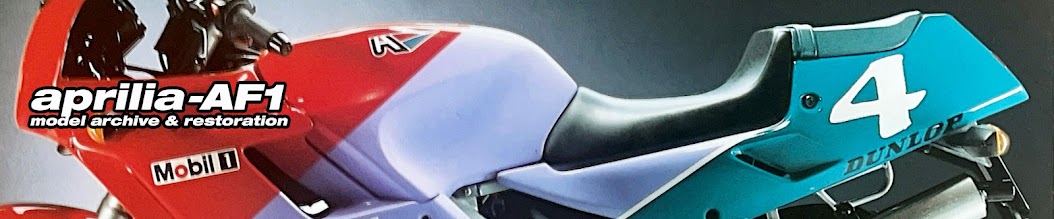
Thirty horses each of Cagiva Mito, Aprilia Futura & Gilera SP02 by Roland Brown (30-ish) and Colin Schiller (130-ish)
For mile after mile I'd been charging. Tearing down the straights and scratching through the bends as fast as I could go: head behind the bubble, throttle hard against its stop, ears ringing with the sound of straining two-stroke engine, brakes left late for the bends, knee stuck out as I swept through the corners with a nudge on the low-set bars.
And now I was lost. Reaching a fork in the road far ahead of photographer Goldman, who was following with our alleged maps of north-eastern Italy in the car, I realised that I hadn't a clue which way to go. There was no alternative but to park the gorgeous red-white-and-purple Aprilia, sit in the sun and hope that eventually he'd catch up.
It was lucky that I looked up when I did moments later, for
otherwise I wouldn't have noticed our Fiat rentawreck rattling past, barely a
couple of minutes behind and showing no signs of being in a hurry. And then it
dawned on me. The new Futura might look a million dollars (and cost six million
lire), it might be big and brash and beautiful and unbearably well-equipped.
But it is, after all, still a 125.
Despite all my efforts, despite the fact that this tuned and
fully-faired missile was one of the raciest and most high-tech streetbikes I'd
ever sat on, I probably hadn't managed to persuade it to push my unaerodynamic
large body above 100mph all day. For all its upside-down forks and its
single-sided swing-arm and its butch alloy frame, the Aprilia Futura's most
significant feature is nevertheless its engine's capacity of about half your
average-sized shampoo bottle.
In many ways it is the curse of bikes like this, the latest
race-replica to explode onto the Italian teenage market, that for all its
design flair and expensive chassis brilliance the Futura is still just a 125.
That means that its state-of-the-art two-stroke motor puts out 34 horsepower
when the rest of the cycle looks and feels as though it would be more than
happy handling twice that many.
Not that the Futura is slow, you understand. It has a
genuine top speed of just over a ton, and if you keep the tacho needle jabbing
at the 11-grand redline it has acceleration to match. But by sports bike
standards it is obviously short on ultimate performance – which, sometimes, is
also its biggest attraction. The delight of small-bore screamers like this is
that even speed-freaks used to much bigger tackle can enjoy twisting the neck
off a 125 without putting life or licence at too much risk.
That ride across country back to Aprilia’s base near Venice
was memorable by any standards, despite the lack of out-and-out speed, and
travelling half as fast again on the straights would not necessarily have
improved the ride much at all. Lucky is the young Luigi whose rich padre
presents him with one of these on his birthday. What I'd have made of being
planked on this motorcycle at the age of 17 I can’t begin to imagine, and I
suspect that it’s probably just as well I didn’t have the chance to find out.
British novices won’t find out immediately either, of
course, because they’ll be restricted to a 12bhp version of the Futura – one
that, after riding the full-power version, must feel as though it’s still
parked on the centrestand (not that any AF1 is weighed-down by any such
encumbrance, of course). All the more reason for passing your test, after which
time, on being shown a photocopy of the owner’s full licence, the new Aprilia
importers will forward free-of-charge the exhaust power-valve that restores the
missing ponies.
Aprilia Moto UK won’t be providing anything at all for the
Futura for several months, it must be said, because they can’t get stocks of
the new bike yet and will initially concentrate on selling the established AF1
Replica model. When the Futura does arrive it is likely to prove boss of the
strada in the 125 class – just as it has in Italy, where it’s apparently
outselling all competition.
The Futura is basically the latest version of the AF1
series. It effectively brings together the Replica and the AF1 Sport – the very
similar but slightly more powerful production-race version of the twin-headlamp
screamer – to produce one new machine that is even slicker, even tricker and
even more obviously suited to the racetrack than its predecessors.
It seems almost unnecessary to say that the Futura will
eventually be the only AF1 model. Short of selling the bike with its bolts
already lockwired, or perhaps with a roll of duct-tape and a couple of spare
fairings, it’s hard to imagine how Aprilia could come out with a “sport
production” version of this. (No doubt they could if they tried, though, and
perhaps they will if their baby starts getting whopped on the track.)
The main difference between the Replica and Sport models is
the carburettor, which is a Dellorto that grows all the way from 28mm to 34mm
for the competition bike. The Futura gets a slightly modified version of the
bigger fuel-bucket, batch, which helps push claimed output up one whole donkey
from the Replica’s 32.8 to 33.8hp precisely, at 11,000rpm.
Compression ratio is actually reduced slightly, from 15:1 to
13.6:1 (don’t compare those numbers with Jap tackle, mind – they’re measured
from B.D.C. rather than exhaust port closing), but the rest of the motor stays
virtually unchanged. It’s a watercooled two-stroke single, built by Rotax to
Aprilia’s spec. It has almost square bore and stroke dimensions of 54 x 54.5mm,
a balancer-shaft to damp out vibration, and an electronically operated exhaust
valve that is appropriately named RAVE, and really gets the party swinging
after eight (thousand rpm, not pm).
The exhaust itself is a similar specimen that bulges out
below the motor before heading up to a neat tailpipe on the left of the bike.
On the other side of the engine, the Sport’s side-mounted airbox is replaced by
a more central chamber that sits between the top tubes of the bolt-on rear
subframe, and is shrouded by plastic and fed by two long plastic ducts running
back from the nose of the fairing.
The main frame is a modified version of Aprilia’s aluminium
alloy twin-spar job, and is so neat and sturdy-looking a piece of kit that it
wouldn’t disgrace something from down the coast at Bimota, let alone a puny
mass-produced 125. The main extrusions now bulge out a little on their route
from steering head to swing arm pivot, and an alloy plate has been added on
each side of the subframe, presumably for reinforcement. But the most obvious
difference is that the satiny main spars have been left on view instead of
covered by bodywork as they were before.
Being an Aprilia, the only way that this 125cc motorcycle
would not have featured upside-down forks and a single-sided swing arm is if
the Noale firm's designers had found a way of equipping it with hub-centre
steering, a single-sided front fork, a hubless rear wheel or something even
more weird and over-the-top. (Unfortunately, Aprilia wouldn't reveal what
tablets their creative crew are fed on.)
The suspension set-up at each end looks seriously serious,
and the Futura's forks and shock combine with the hugely rigid frame to give
handling that matches the spec. One surprise is that the suspension is
non-adjustable. It's firm but I felt no desire to change things, and for
novices the lack of fiddling potential is probably a good idea.
Second surprise is that the steering is not ultra-quick, at
least by small-bike standards. The Replica's rake and trail have been kicked
out half a degree and 3mm to give 26 degrees and 95mm, which is not radical by
current standards.
What that means is that the little bike that looks like
Yamaha's 0W01 actually feels a little reminiscent of the super-solid 750 too,
ludicrous as that may sound. (Part of the reason is that Futura is not little
at all. It is a leading example of the trend that has seen small-capacity bikes
getting physically bigger while big bikes get smaller; presumably one day
they'll cross in the middle.)
The similarities start early. From the pilot's perch on the
skimpy seat, far more thinly-padded even than the Replica's, it's a fair reach
to the low clip-ons across a fuel tank whose flush-filler is labelled with the
specious words "specially developed for racing", in case you were in
doubt. The wickedly curving screen comes up to meet your wild-eyed stare. Below
it, the cockpit houses a typical array of partially foam-mounted dials, and is
bordered by a pair of surprisingly useful mirrors.
Feet are held predictably high but the Futura feels so long and generally roomy that its hard to believe this really is just a 125. (Unless you are riding pillion, which requires membership of the National Union of Contortionists.) Press the button, hear the tinny two-stroke rattle and, well, perhaps it is a 125 after all. Then you pull away – or rather this flash – leather-suited professional test rider attempted to pull away, failed to give the gutless motor enough revs, and stalled right outside the factory's front door. Thank God for dark visors.
There's very little power below about 4000rpm but once you get used to keeping the single singing that is really no great problem. Acceleration from there until about 7500rpm is pretty limp, but then the power-valve chops in, the exhaust note changes dramatically from a flat drone to a high-pitched shriek and – in the lower gears, at least – the Futura hurtles towards the 11-grand redline with great aplomb (and with a slight-but-not-troublesome tingling through the 'bars and seat).
If a corner should intervene before the Futura has had a chance to stretch its legs in sixth gear, then so much the better. A squeeze on the big single disc, which is progressive but not as brain-rotatingly potent as I'd expected from a bike weighing only 250lb, brings the speed down instantly. Then you shuffle across the seat, flick the Futura into the bend and attack the throttle again after making sure to Get That Knee Down if at all possible. You owe it to the people who designed this bike, after all.
Naturally, it's in bends that the Aprilia exudes the classy
feel of a serious track-ready motorcycle. There's none of the nervous,
underdamped feel that comes with many small sportsters. You need a little
effort on the bars to move the front wheel off-line, after which the Futura
tracks with absolute precision and holds its line with wondrous stability even
in ripply corners.
Both wheels are five-spoke 17-inchers instead of the
previous seven/nine spoke design, and they wear radial Dunlops whose generous
widths and soft compound allow the Futura to be whistled through corners as
fast as just about anything on two wheels. Then you're back on the power, the
single-pot motor is revving hard, your left boot is flicking frantically and
your head is back behind the screen as you flog the guts out of those
thirtysomething horses... For a 17-yr-old a brilliantly enjoyable sportster;
for a motorcycle journalist more than three grand it's just a brilliantly
enjoyable scratcher, but... Aprilia Moto UK, the new British importers, hope to
receive stocks of the Futura early next year. They plan to sell it for a little
more than the AF1 Replica costs now, which is £3134. That's much closer to the
price of Suzuki's RGV250, for example, than the RG125.
If you're a 17-year-old learner with that sort of money to
burn, then by now you probably don't need directions to the nearest Aprilia
showroom. Anyone else would have to be pretty sure that they really wanted to
get their two-wheeled kicks from head-down, no-nonsense mindless boogie on a
bike with the cornering power and charisma of a Ferrari but the out-and-out
speed of a Fiat Panda.
Adrenalin junkies with dirty licences, this is the bike for
you.
CAGIVA MITO / GILERA SP02
Only two things count in the Italian motor industry, whatever the vehicle and whatever the cylinder capacity – speed and style. And the Mito oozes them in such abundance that the performance-hardened speed junkies that constitute the bulk of Italian youth were virtually guaranteed to be tripping over themselves to lay huge wads of their old Man's lira down the moment the Mito was announced. Whilst the world's motorcycle press continue to muse over Cagiva's apparently unbounded promotional, investment and sporting budget, the Castiglionis have obviously got all sectors of the indigenous Latin market well and truly sussed.
The Mito is a no-holds-barred bum-up-head-down motorcycle stamped, like a chocolate replica, straight out of the same mould as Randy's GP bike. Like Gilera's SP02 it has a kind of variable BHP output from its single-cylinder 56 x 50.6mm engine largely depending on whose asking. Unlike the Gilera, which utilises crankcase induction to achieve its similarly mystical 31, possibly 34bhp, a cylinder situated reedvalve, allied in its case to 'CTS' power valve, produces the optimum spread of power.
I have to tell you that if this is the optimum, I'd hate to have to ride the Mito off the pipe. Ever seen 125 GP bikes 'paddling' off the line for improved getaway? Ride the Mito and you know how stupid they feel. If you're looking for a wheelie machine, you'd be better off with a hoop 'n' stick. The Mito has the kind of low to mid-range power that'd be hard-pushed to tow an empty packet of crisps, but hit 9,500rpm and power's released like a broken bungee, at least for 1500rpm. After that it's all over and you have to click up another cog yet again in the Mito's seemingly endless box of seven.
The reason for this peculiarly masochistic means of propulsion is top speed and the Mito'll kick out as near to 110mph as you're ever likely to see from this year's crop of 125s. Every single facet of the engine's design and construction from its radar shaped water-jacket to the race-cut transmission is geared toward that one statistic. Though whether it is significantly faster than the Futura would have taken a longer stretch of mountain coast road and a firmer guarantee of the Carabinieri's disinterest than this paranoic from Sudetanland was willing to risk.
It does, however, certainly feel faster than the either the Futura or Gilera, though this may have been a function of its radical riding position and suspension as much as its engine characteristics. The Gilera exudes none of the raw and 'hard' delivery that is the Mito's overriding characteristic, but instead sustains a smooth and progressive surge of power, 3000rpm lower down the rev range than the Cagiva at 6000rpm, then building cumulatively until the redline 4500rpm further. Again, 100mph is dismissed with relative ease despite the parsimony of a mere six ratios. But of course the ascent toward the ultimate figure demands circumstances a little more scientific than your nose on the bottom yoke and a prayer that the road designer was in one of his more unimaginative phases. Whatever, the 110mph 125 road-bike is now genuinely upon us.
Don't get me wrong about the advantage the Mito may have in top speed – it's marginal over either the Futura or the SP02 and from a standing start for instance, the Mito'd still be 'Wherppppp-bhorrring' when both the Gilera and the Aprilia'd reached 60mph. But the Cagiva has been built for a purpose, and in the pursuit of that purpose, you have to admire the single-mindedness of its execution.
Nowhere is the evidence of that single-minded stance more evident than in the conception of the Mito's architecture and riding position. You have to remember that Italian youth rides everything in shorts, Benetton singlets and deck-shoes, which is why almost all of them have at least one area of flesh which is not the standard nauseating olive brown but a tender, plasticky pink. But the advent of the Mito, along with the recent compulsion to wear helmets, might change all that. For whilst it is still aimed at an uncompromisingly juvenile market, it is the boldest statement yet of motorcycling as a serious means of transport rather than as a largely unregulated 'fun' pastime used as a stepping-stone to car ownership.
Twin-spars are in fashionable works racer format on the Mito with all the essentials in extruded aluminium. This design with the small two-stroke unit suspended below is now so successful, it's difficult to understand how so straight, obvious and uncomplicated a path could have been avoided for so long. Ditto the Gilera whose upper spars would have given Sheene & Robert's first Vee Four's in 1982 a run-for-their-money size-wise; probably stiffer too. On the Cagiva, you are head-down-peering-over-the-paint as soon as you cock a leg over it's unbelievably sparse perch and it's thus impossible to ride the Mito with anything other than really serious intent. The latitude for movement in the pre-load adjustable 'Soft-Damp' monoshock would not be out of place on the drawing-board at Tatra or Perllini, let alone a bike manufacturer's. It simply does not move and is almost as hard as Mamola's GP bike which I sat on beforehand, yet it traces the road with unbelievable control and precision.
The rugged steel banana swing-arm is the perfect companion to this set-up and makes Gilera's rear fork look sick by comparison. Even the Futura cannot compete with this specification and there is little doubt that the Mito sets new standards in the class.
By comparison, the SP02 is distinctly rear-end soft, with a far more supple approach to both seating and suspension than either the Mito or Aprilia. Nothing wrong with that per se, but get the Gilera near its limit and the more rideable, more forgiving back-half does become its lowest common factor, particularly when you consider that with 40mm Forcella 'Upside-Downers' at the pointy end it's hardly likely to be this part that's ever going to let you down. In this respect it is as odd a combination as the Mito's super vogueish rear fork yet understated, plain old pre-load adjustable Forcellas; the only difference is that in the Cagiva's case, the simple components do not become the bike's limiting factor.
Again, criticism of the Gilera's shortfall against the Cagiva is irrelevant in all but the most frantic of scratching situations. Yet as the Mito has the reputation for being the state of the art bike in terms of handling, it's the belief and confidence in this fact, rather than any inherent advantages of the bike, that are likely to reinforce that superiority on the road. But the differences are negligible, and it's a good rider, not a rear spring that'll make the difference.
Certainly there is little to choose between the two bikes as far as either steering or stability is concerned and both do asset with scalpel like precision. But again, straddle either with any serious intent and you know after the first 100 metres that the Mito is going to come out tops. The tautness of the plot encourages the sensation that directing the Mito is not a conscious exercise performed at the bars, but is somehow more natural, more subliminal and integral with riding the bike as a whole. Both Gileras and Cagiva demonstrate admirable neutrality; the former turning a little quicker by virtue of its 16" as opposed to 17" front wheel, the Mito a smidge 'slower' perhaps, a little less agile, but producing more a feeling of 'oneness between steering and handling. It should not be underestimated either how great a combination the Michelin 150 rear radial (the same size as fitted to an FJ1100!) makes to both stability and the extent of grip on long turns and it's 20mm extra width is a clear advantage over the SP.
If that isn't enough, the Mito also wears the deadliest front stopper ever fitted to a 125. It hauls the bike up with the authority normally only associated with twin disc set-ups and its twin-pot Brembo caliper works with the progressiveness which has always been the hallmark of Italian braking systems. Giving 20mm away in size to the Mito, despite its almost identical set-up, the home-grown Gilera kit just cannot match it, though again we're splitting hairs in awarding positions. At least they died for position in the rear brake dept with both being as average as their floating versions are exceptional. But then in a country where sunshine is the greatest natural resource, what the hell does it matter?
Probably about as much as the standard of finish, something for which we know the Latins are a legend in their own lunchtime. Well sometimes; even when standard de-course factory fare is involved must be getting shorter, because the finish and equipment on both bikes are almost ornate by previous criteria, except mysteriously for the front-brake master cylinders which were perched so precariously and untidily on both that you wondered who copied who. Nope, in general I was almost shocked by the level of fixtures 'n' fittings such as the classy clip-ons and fillers of the Gilera and the instruments, fuel-tap and perfectly crafted fairing of the Cagiva. But if either of them, particularly the latter is serious about pillions, count me out.
We Brits have never really understood the obsession with small capacity two-strokes in Italy; until about 1987, we regarded them in much the same way we look upon mopeds in Majorca once a year. But to Italian youth, these extra shades of performance, these edges of styling are critical. By those standards alone 1990 looks like being Cagiva's year. And in a way, that's a shame, because the Gilera is probably the best 125 road-bike ever to come out of Italy. Perhaps the only consolation to Italian adolescents in this perplexing choice is that they need no licence whatsoever to ride either of them ....

 |


